
Fleece Fabric Guide: 300GSM vs 400GSM for Hoodies
A practical guide to fleece fabric weights for hoodies. What 300GSM and 400GSM mean, when to use each, and what to specify when ordering in bulk from Pakistan.
What Fleece Fabric Actually Is and Why It Matters for Hoodies
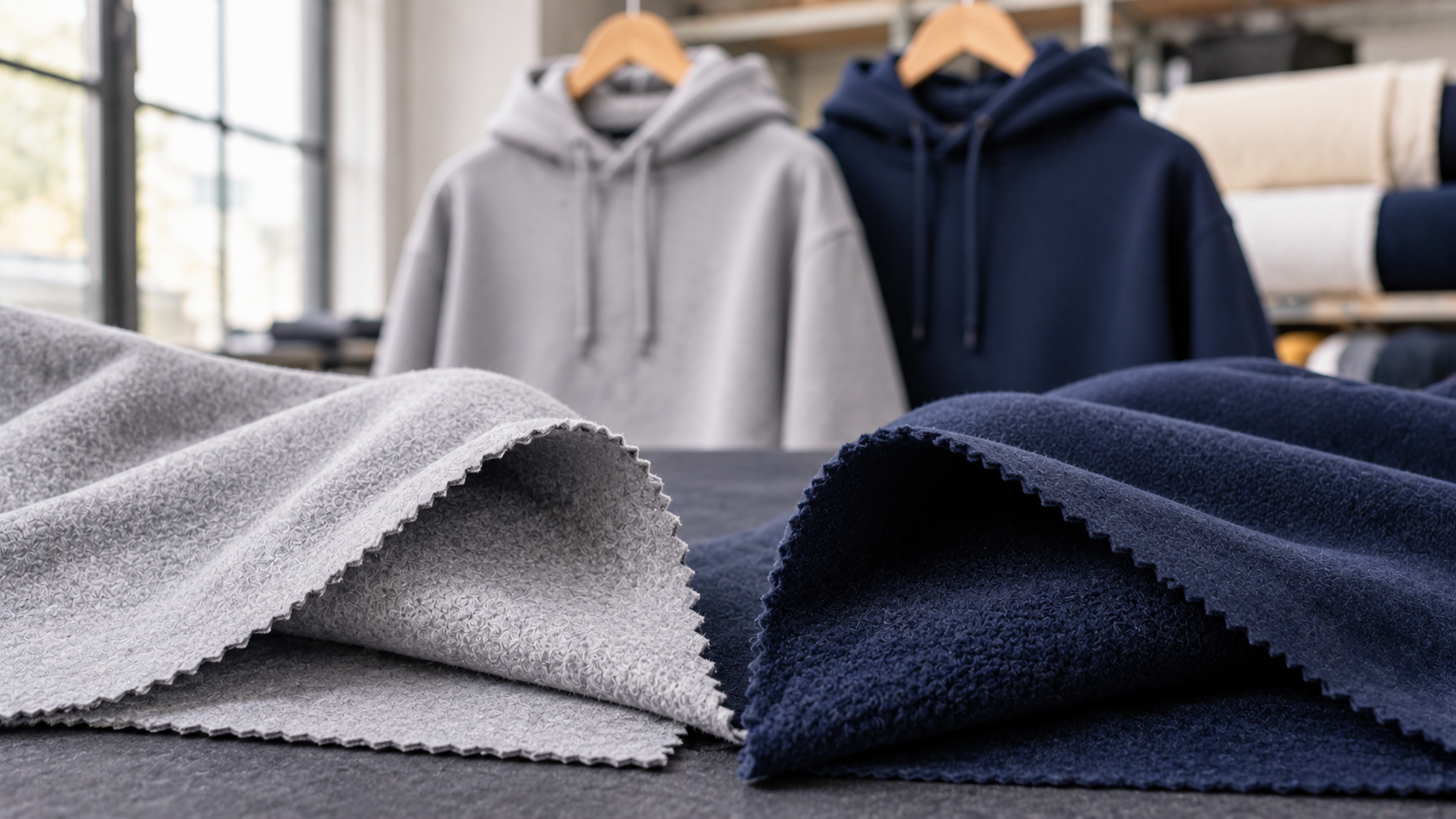
Fleece is a knitted fabric with a brushed or looped interior that traps warmth. It is the standard fabric for hoodies, sweatshirts, and joggers across most clothing brands. The exterior is smooth or textured, and the interior is soft and insulating.
UMAAS Exports produces fleece fabric hoodie orders from its factory in Lahore, Pakistan. Fleece is one of the core fabric types used across the hoodie and sweatshirt product range, alongside cotton and blends.
The most important variable when specifying fleece is the GSM. It tells you how heavy the fabric is, which directly affects warmth, drape, durability, and how the garment sells in different markets and seasons.
- Fleece is a brushed knit used for hoodies, sweatshirts, and joggers
- The interior traps warmth while the exterior stays smooth or textured
- GSM is the main variable — it determines weight, feel, and seasonal suitability
- UMAAS Exports produces fleece hoodies and sweatshirts as a core product line
Fleece weight is not just about warmth. It affects how the garment looks on the hanger, how it ships, and what your customer is willing to pay for it.
How Fleece Weight Affects Your Hoodie Order
GSM determines more than just warmth. For a 300GSM fleece or 400GSM fleece order, the weight touches four things that matter to a clothing brand: how the garment feels in hand, how it photographs, what it costs per unit, and what it weighs for shipping.
A heavier fleece feels more substantial when a customer picks it up. That physical weight creates a perception of quality that lighter fabrics cannot replicate. It also means the garment holds its shape better on the hanger and in flat lay photography — which matters for your product shots.
On the cost side, heavier fabric uses more material and ships heavier. At small quantities this difference is minor. At scale — hundreds or thousands of units — the GSM you choose affects your landed cost per unit and your margin.
Picking the wrong weight is one of the most common first-order mistakes. Ordering too light because it costs less usually results in a garment that feels cheap and is hard to sell at the price point you planned.
GSM affects feel, photography, cost, and shipping weight. Picking the wrong weight for your market is an easy mistake to make and an expensive one to fix after samples are approved.
300GSM Fleece: What It Is Best For
300GSM is the most common weight for everyday hoodies. It has enough body to hold its shape and photograph well, without being so heavy that it feels stiff or ships at a high cost per unit. It is the go-to weight for year-round basics, streetwear drops, and brands entering the market for the first time.
A 300GSM fleece hoodie sits in a sweet spot between comfort, cost, and versatility. It is warm enough for mild cold but light enough to wear in autumn and spring without overheating.
- The most common weight for everyday branded hoodies and streetwear
- Warm enough for autumn and mild winter, light enough for spring layering
- Holds shape well on the hanger and photographs cleanly in flat lays
- Lower shipping weight per unit compared to 400GSM — relevant at scale
- Ideal for a first hoodie order or a year-round basics collection
If you are unsure which weight to start with, 300GSM is the safer choice. It works across more markets and more seasons than 400GSM.
400GSM Fleece: What It Is Best For
400GSM fleece is heavier, warmer, and more premium in feel. When a customer picks up a 400GSM fleece hoodie, the weight is immediately noticeable. It signals quality in a way that lighter fabrics cannot. This makes it a strong choice for premium drops, winter-focused collections, and brands competing on perceived value.
The tradeoff is cost. A 400GSM hoodie uses more fabric, weighs more for shipping, and typically costs more per unit than a 300GSM equivalent. For brands with a higher retail price point, this cost is absorbed easily. For budget or entry-level brands, it can squeeze margin.
400GSM also works well in markets with colder winters — the UK, Canada, northern Europe — where customers genuinely need the warmth and are willing to pay for it.
- Noticeably heavier in hand — signals premium quality immediately
- Warmer and more suitable for autumn through winter drops
- Works well for limited drops, premium basics, and high retail price points
- Stronger perceived value at point of sale compared to lighter weights
- Higher per-unit cost and shipping weight — factor this into your pricing
400GSM is for brands that want the garment to feel expensive when someone picks it up. If perceived quality is part of your brand story, the extra weight earns its cost.
Fleece Construction: French Terry vs Fleece-Back Cotton
When specifying bulk hoodie manufacturer orders, weight alone does not fully describe the fabric. The construction also matters and affects the texture, warmth, and finish of the final garment.
French terry is a loop-back knit with a smooth exterior and an unbrushed looped interior. It is lighter and less insulating than brushed fleece. It is used for mid-weight hoodies and sweatshirts where you want structure without heavy warmth.
Fleece-back cotton is brushed on the inside, creating a soft, warm interior. This is what most people mean when they say "fleece hoodie." It is used in the 300 to 400GSM range and is the standard for heavyweight hoodies and cold-weather sweatshirts.
Always specify whether you want French terry or brushed fleece-back alongside your GSM. The two fabrics feel completely different even at the same weight.
- French terry: smooth exterior, looped unbrushed interior, lighter and less warm
- Fleece-back cotton: brushed interior, softer and warmer, standard for heavyweight hoodies
- Both can hit similar GSM numbers — the construction determines the feel and warmth
- Specify construction in your brief alongside GSM to avoid getting the wrong fabric
French terry and fleece-back are not the same fabric. At the same GSM, they feel different and perform differently. Always name the construction in your order.
Ordering Fleece Hoodies Through UMAAS Exports
UMAAS Exports produces custom fleece hoodies and sweatshirts from its factory in Lahore, Pakistan. Fleece is one of the core fabric types in the product range, used across hoodies, sweatshirts, and tracksuits.
Pantone colour matching is available so your fleece garments come back in the exact shade you specify. Decoration options including screen printing, DTG, DTF, embroidery, sublimation, puff print, acid wash, and rhinestone are done in-house.
MOQ is 30 pieces per design with sizes mixed within that run. Lead time is 26 to 42 days from sample to dispatch. UMAAS has been exporting since 2018 to the UK, US, Canada, Germany, Spain, and the EU.
For a heavyweight hoodie bulk order, send your GSM target, fabric construction, colour, and decoration details through the contact form or WhatsApp to receive sampling options and a quote.
MOQ 30 pieces per design. Pantone colour matching available. Lead time 26 to 42 days.
Ready to start production?
Tell us about your brand, product, and quantities. We will reply with samples, pricing, and timelines.